NePTune: A Neuro-Pythonic Framework for Tunable Compositional Reasoning on Vision-Language
Michigan State University
International Conference on Learning Representations (ICLR), 2026
Best Paper Award, MSLD 2026 Oral, SpaVLE Workshop @ NeurIPS 2025
From question to program to tree
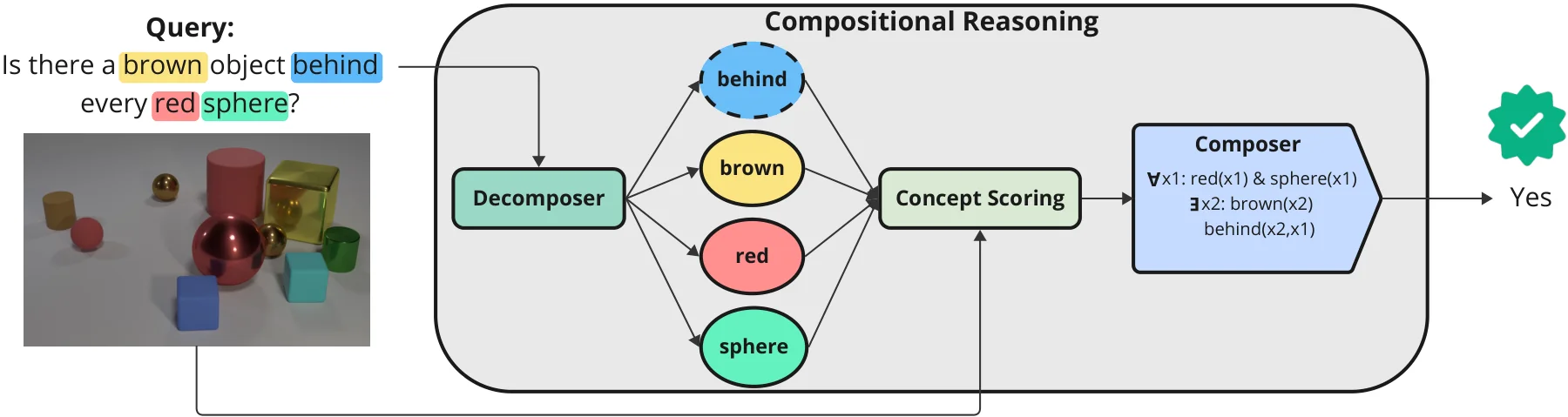
This walkthrough follows the example in Figure 2 of the paper. The program is shown first as Python code and then as a tree. Green nodes are concept scores from the vision-language model (VLM), blue nodes are soft logic, and purple nodes are ordinary Python. The declarative part scores every detected box at once. The imperative part then loops over the boxes, branches on their scores and counts the answers. Press ▶ to play or pause, use the numbered steps to jump, and hover over a line of code or a node to see its counterpart.
Loading the example…
Tunable end to end
Every soft-logic operator in NePTune has a differentiable implementation, so a program also carries gradients. This walkthrough uses a referring expression from Ref-GTA, Expression 1 of Figure 3 in the paper, whose program is a single first-order-logic formula. After the forward pass, a binary cross-entropy loss on the program’s answer flows back through iota and the soft AND into the concept scores, and from there into the VLM. This is how the paper fine-tunes a VLM for Ref-GTA, a video game domain that is new to VLMs trained on natural images.
Loading the example…
Abstract
Modern Vision-Language Models (VLMs) have achieved impressive performance in various tasks, yet they often struggle with compositional reasoning, the ability to decompose and recombine concepts to solve novel problems. While neuro-symbolic approaches offer a promising direction, they are typically constrained by crisp logical execution or predefined predicates, which limit flexibility. In this work, we introduce NePTune, a neuro-symbolic framework that overcomes these limitations through a hybrid execution model that integrates the perception capabilities of foundation vision models with the compositional expressiveness of symbolic reasoning. NePTune dynamically translates natural language queries into executable Python programs that blend imperative control flow with soft logic operators capable of reasoning over VLM-generated uncertainty. Operating in a training-free manner, NePTune, with a modular design, decouples perception from reasoning, yet its differentiable composition operations support fine-tuning. We evaluate NePTune on multiple visual reasoning benchmarks and various domains, utilizing adversarial tests, and demonstrate a significant improvement over base models, as well as its effective compositional generalization and adaptation capabilities in novel environments.
How NePTune works
score draws the box in red and returns p(Yes) from the logits of “Yes” and “No”, and query returns a short text answer.& and | compose the score tensors with soft logic, and loops, conditionals and variables give the program the full power of Python.Soft logic operators
| Syntax | Logical form | Description | Differentiable implementation |
|---|---|---|---|
αx.exists() | ∃x αx | Existential quantification | max(αx) |
αx.forall() | ∀x αx | Universal quantification | min(αx) |
αx & αy | αx ∧ αy | Logical conjunction | min(αx, αy) |
αx & βxy | αx ∧ βxy | Relational conjunction | ∑y αx · βxy |
αx | αy | αx ∨ αy | Logical disjunction | max(αx, αy) |
αx.implies(αy) | αx → αy | Logical implication | max(1 − αx, αy) |
not αx | ¬αx | Logical negation | 1 − αx |
αx.iota(var) | ι(var, αx) | Best match | softmax(αx) |
αx.count() | count(αx) | Counting elements | ∑ αx |
s1 == s2 | s1 = s2 | Scalar equality | σ(τ(γ − |s1 − s2|) / γ) |
s1 > s2 | s1 > s2 | Scalar inequality | σ(τ(s1 − s2 − 1 + γ)) |
Table 2 of the paper. α is an object-centric or scalar probabilistic score, β is a relation probability score, τ = 0.25 is a temperature and γ = 0.25 is a margin.
Key results
CLEVR
| InternVL2.5 | NePTune | ViperGPT | NeSyCoCo | LEFT | |
|---|---|---|---|---|---|
| Zero-shot: the backbone VLM (end-to-end), NePTune and ViperGPT (neuro-symbolic). Trained: NeSyCoCo and LEFT | |||||
| Final accuracy | 90.25 | 92.65 | 36.05 | 99.68 | 99.50 |
| Exist | 87.10 | 93.19 | 48.75 | 99.28 | 98.92 |
| Query attribute | 98.26 | 96.81 | 29.42 | 100.00 | 99.86 |
| Compare attribute | 98.61 | 91.94 | 53.06 | 99.44 | 99.72 |
| Count | 74.60 | 87.10 | 21.37 | 99.79 | 98.99 |
| Compare number | 90.86 | 92.57 | 48.57 | 100.00 | 100.00 |
Table 3 of the paper, showing accuracy (%) by question category. Bold marks the best zero-shot result. NePTune is the strongest zero-shot neuro-symbolic method, and its largest gain over the backbone is on counting (+12.50).
Declarative and imperative together
| Ablation setting | CLEVR-Humans |
|---|---|
| Declarative + trained concepts | 56.12 |
| + VLM concepts | 68.48 (+12.36) |
| + Imperative reasoning | 87.67 (+19.19) |
Table 10 of the paper, showing accuracy (%). Starting from a purely declarative reasoner, scoring concepts with a VLM adds 12.36 points, and adding imperative reasoning adds another 19.19.
CLEVR-Humans
| Method | Accuracy |
|---|---|
| Trained | |
| LEFT | 56.69 |
| NeSyCoCo | 56.12 |
| MDETR | 81.73 |
| Zero-shot | |
| Qwen2VL-7B | 84.12 |
| InternVL2.5-8B | 85.95 |
| Ovis1.6-9B | 79.96 |
| ViperGPT | 31.05 |
| NePTune | 87.67 |
Table 5 of the paper, showing accuracy (%) on human-written questions.
CLEVR extensions
| Method | Ref | Puzzles | RPM |
|---|---|---|---|
| Trained | |||
| NeSyCoCo† | 100.00 | 95.00 | 100.00 |
| NeSyCoCo | 94.00 | 94.00 | 74.00 |
| LEFT | 94.00 | 85.00 | 87.00 |
| Zero-shot | |||
| Qwen2VL-7B | 21.00 | 43.00 | 53.00 |
| InternVL2.5-8B | 27.00 | 52.00 | 47.00 |
| Ovis1.6-9B | 4.00 | 47.00 | 49.00 |
| ViperGPT | 8.00 | 34.00 | 4.00 |
| VisProg | 35.00 | 27.00 | 51.00 |
| NePTune† | 99.00 | 65.00 | 99.00 |
| NePTune | 91.00 | 60.00 | 80.00 |
Table 4 of the paper, showing accuracy (%) on referring expressions (Ref), visual puzzles and Raven’s progressive matrices (RPM) built on CLEVR. † marks methods that use ground-truth programs.
Domain shift and fine-tuning: Ref-GTA
| Method | Ref-GTA |
|---|---|
| GroundingDINO-B | 27.90 |
| Florence2-L | 58.65 |
| Ovis1.6-9B | 2.78 |
| InternVL2.5-8B | 6.95 |
| InternVL2.5-1B | 1.64 |
| + Fine-tuning | 32.61 ±0.35 |
| ViperGPT | 1.40 |
| NAVER† | 54.84 |
| NAVER | 58.73 |
| NePTune‡ | 62.73 |
| NePTune | 69.69 |
| NePTune (1B) | 34.92 |
| + Fine-tuning | 69.90 ±1.16 |
Table 7 of the paper, showing grounding accuracy (%) on images from a game engine, a domain shift that the VLMs were not trained on. Fine-tuning a 1B VLM through NePTune’s differentiable computations with only 1,000 samples reaches 69.90, while standard fine-tuning of the same VLM reaches 32.61.
Real images: Ref-Adv
| Method | Ref-Adv |
|---|---|
| Grounding DINO-B | 60.85 |
| Florence2-L | 71.73 |
| Ovis1.6-9B | 30.70 |
| InternVL2-8B | 72.92 |
| InternVL2.5-8B | 76.13 |
| ViperGPT | 60.66 |
| NAVER† | 36.45 |
| NAVER | 65.13 |
| NePTune‡ | 63.71 |
| + Verification | 75.54 |
| NePTune | 71.57 |
| + Verification | 78.08 |
| NePTune (1B) | 60.69 |
| + Fine-tuning | 68.06 ±0.56 |
| + Verification | 74.59 ±0.12 |
Table 6 of the paper, showing grounding accuracy (%) on RefCOCO-Adversarial. NePTune‡ uses the same backbones as NAVER, and NAVER† is NAVER’s execution step on its own.
NePTune was accepted to ICLR 2026 and was presented as an oral at the SpaVLE workshop at NeurIPS 2025.
BibTeX
@inproceedings{kamali2026neptune,
title={Ne{PT}une: A Neuro-Pythonic Framework for Tunable Compositional Reasoning on Vision-Language},
author={Danial Kamali and Parisa Kordjamshidi},
booktitle={The Fourteenth International Conference on Learning Representations},
year={2026},
url={https://openreview.net/forum?id=8H0TkSusWI}
}